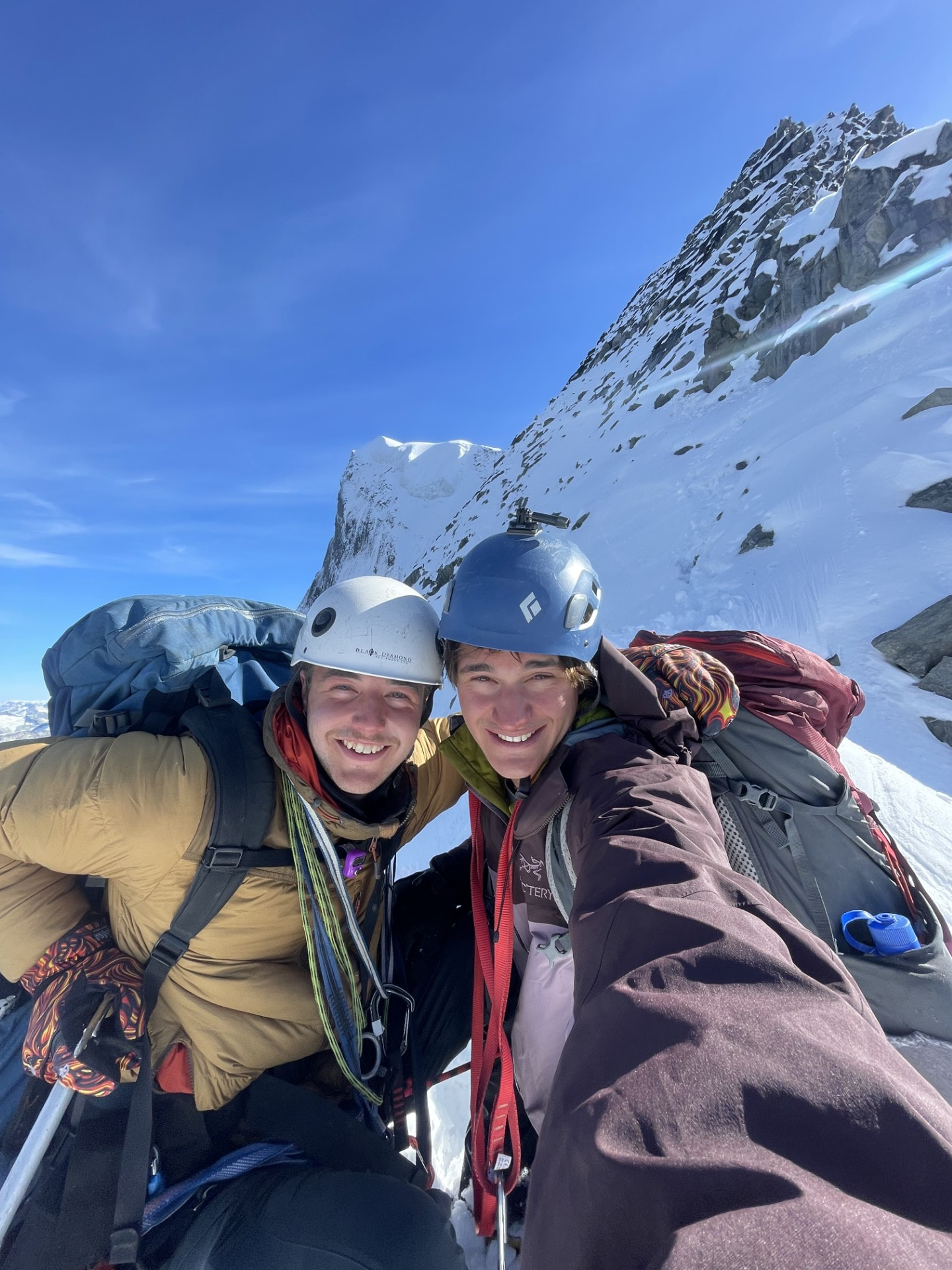
Author: Asa Pichton, Recipient of Memorial Fund Youth Grant
I felt the solid rock beneath me. I closed my eyes, relaxed, and breathed in deeply. I reminded myself that things were going well. I felt good. The fear was present, but I could overcome it. When I was ready, I continued on. This was a practiced task, one that is essential for managing risk. You must experience the fear, analyze it plainly, and then act - it cannot control you. I sat straddling Mount Queen Bess’s North ridge, both legs pointing down towards its sheer faces as I gazed upward. Around a rocky outcropping fifteen meters below me stood my climbing partner Jude Thompson, belaying and silently hoping that I was experiencing easy terrain.
“How is it?” He yelled, hardly audible.
“It’s not terrible - I just can’t find anywhere to place anything”, I yelled back.
Ahead of me lay a significantly steeper section of snow. I knew it would be at least another five meters before I could place another piece of protection, and that was only if the boulders ahead weren’t loose, a rarity. We had been moving since before sunrise, it was now just past 4 PM. Ever since the saddle in the ridge our progress had been slow. I was beginning to have doubts, and I suspected Jude felt the same. For now I pushed on, and tried to imagine I was above a bolt and not a suspiciously angled gear placement.
Mount Queen Bess lies deep in the heart of British Columbia’s Coast Mountains, over 50 kilometers from a paved road in any direction. Its steep faces and striking prominence make the mountain a breathtaking sight. During an expedition that made the second ascent, it was remarked that “Queen Bess won the unanimous vote as the most beautiful peak we had ever seen”. Because of its remote nature and proximity to the more widely known Mount Waddington, Queen Bess is hardly ever visited. This obscurity is exactly what drew Jude and me to the mountain, and when we were unable to find any record of a purely overland ascent since the 1950s, we knew we had to try for ourselves.
A mixture of dread and excitement filled me as I finished packing and felt the full weight of my 60 pound pack. Jude and I locked eyes and laughed, were we really getting ourselves into this again? In the previous year we had made an attempt at the mountain. We had crossed rivers, untracked valleys, and forests of fallen trees. We had
persevered for days through dense bush, and climbed an unexplored couloir of loose rock, only to realize that our ambitions were too grand. At the time, both of us spoke of never returning to those valleys, it simply was not worth it. We would have to wait until we had the money to charter a helicopter. But here we were, standing in the living room of Jude’s childhood home in the Tatlayoko lake community, trying to be excited about the arduous journey ahead. Even though it was a possibility, neither of us could bear the thought of a second 80 kilometer bushwhack without a summit to show for it.
With zero knowledge of the land, It was almost hard to believe that in the previous year we had completed the journey that was to come. Our approach started at the south end of the mighty Tatlayoko lake, or Telhiqox Biny, in the traditional language of the Tŝiilhqot’in. There is no record of any other travellers ever going on foot up the Nostetuko River valley as we have, although it is worth noting that this does not mean it has not been done. Historically, families from the Xeni Gwet’in community in the Tŝiilhqot’in Nation have traversed the mountains to reach Bute Inlet, the closest access to the Pacific Ocean. This was done in order to trade with coastal communities who offered goods which they did not have access to, and to escape the harsh winters of the Tŝiilhqot’in Plateau(1). While it appears as though the traditional crossing settled on a route just south of Mount Queen Bess’s range, it is likely that indigenous explorers of the time looked for passages through the same valley that Jude and I trekked through. Nevertheless, once we had crossed the river on the first day, we saw zero signs of humans for the entire journey.
Our enthusiasm died when we arrived at the previous year’s log crossing, it was half underwater. It was looking like our only option was to continue on, and hope to find a suitable spot to attempt to swim instead. With the light fading, we crashed through the trees and arrived at a remarkably straight and wide section of river.
After unpacking and organizing our gear into contractor bags, I stripped down and tied our rope to my waist. Once on the other side, Jude would tie each bag one at a time to the middle of the rope, ready for me to pull across to my side of the river. We didn’t have much light left, I had to go. Adrenaline flooded through me as I felt the icy power of the water. Slack from the rope was being pulled down by the force of the river, forming a long arching parabola behind me, serving as an additional force holding me back. I could feel the wet rope digging into my skin under the water. After reaching the safety of the opposite riverbank, twenty excruciating minutes were spent pulling the bags back and forth with the rope. Our first major obstacle had been completed.
Our GPS track from the previous year proved indispensable for our approach, and it was with it that we managed to traverse the thirty kilometers to our alpine camp within only two days. By now, we had knowledge of what obstacles to avoid. We also now knew where to find the numerous animal trails that snaked their way along the river; their benefit to our efficiency cannot be understated.
The night before our ascent I laid in my sleeping bag, forcing myself to think positively. We had to get to the top, this much effort had to be worth it. A defeat would be crushing, juxtaposed with the intense elation of a success - both potential options warring to win in my head.
Under the early morning stars, all was silent save for the hissing of the stove. We packed our bags silently and efficiently. Within 30 minutes, we were gaining ground once again, determined to make our second attempt the last. For hours we hiked up boulder fields towards the mountain, its east face glowing ever more orange in the early morning light. Our headlamps were inevitably put away, replaced by crampons to finish the final approach to the ridge up a steep glacier. We had arrived at the couloir, the route we had previously taken to the ridge.
The enormity of the Coast Mountains emerged as we took our final steps onto the ridge. Mount Waddington’s grandeur in the distance was instantly noticeable. I couldn’t help but think of the importance that this vantage point held to Don and Phyllis Munday along with Henry Hall, the first ascent team of Mount Queen Bess, and I realized more certainly why they had put so much effort into that peak; it was truly something to behold. This vantage was also a milestone for Jude and me, as it was our high point from last year. With our inexperience, we had vastly underestimated the time the summit would take. Realizing that continuing would certainly mean a night without shelter or adequate food, we had made the decision to turn around without attempting the ridge itself.
Now was the time to prove we had what it takes. I took the first lead. The snow was firm in the early morning, allowing me to kick-step my way up an initial steep section towards an outcropping of rock that I hoped was solid enough for a sling. Once there, I realized that we were going to be in for a slow climb. About six inches of loose snow covered every rock. This made for a terrifying guessing game where you couldn’t be sure if the rock below the snow was stable. A loose rock not only meant the potential for a fall in any of three directions, but also it falling on top of your belayer’s head. At the outcropping I was able to stomp a good platform and kick at a nearby horn, trusting that its immovability meant it could take a fall, slung it, clipped my rope in, and continued on.
By the early afternoon, Jude and I had gotten into a groove. Trading leads, one of us was always able to find a solid enough place to sling an anchor. With almost every
crack buried, it became evident early on that this was by far the fastest method - there simply weren’t enough options to place enough gear any other way. Nevertheless, we were steadily making progress. Because options were limited, it meant that during a lead, if you were to find a good spot to make an anchor, continuing was risky. Downclimbing back to a suitable anchor after running out of rope was not something either of us could handle the thought of. This led to us doing many short pitches, wasting lots of time in the process, time that was rapidly flying by.
Pitch eight, 3:30 in the afternoon. I stood belaying Jude as he was climbing out of sight around a gendarme, his presence reduced to the steady pull of rope through my belay device. Time was ticking. I began to wonder: in a situation like this, is the accepted practice to trade safety for speed? Maybe a more experienced alpinist would have switched to a simultaneous climbing approach. The thought of giving up the security of an anchor sent a wave of anxiety through me. I wasn’t ready for that. I checked our location, we were still 600 meters from the summit. However, we were on by far the steepest portion of the north ridge, and had only 200 more meters until it appeared as though the angle of incline lessened to near flat.
With each pitch of rope, the snow gradually got deeper. We had initially thought this would be favorable, but it was becoming clear that without snow pickets to protect it, it was far too steep and loose for any alternative except digging out cracks and horns. On top of this, as we climbed higher I began to realize that our retreat options were narrowing. After the ridge flattened, there was no guarantee things would get easier; in fact, the closer we got, the more it seemed they would do the opposite. I estimated that we had enough gear to build about eight to ten anchors for rappelling. How many pitches had we done? Nine? Continuing was risky, and highly committing. It meant the necessity to find somewhere to bivouac for the night. I looked around, there was nothing.
How do people do it? Was this route too grand a goal for our experience? We were shaken, silent, and out of optimism. I could see the disappointment growing on Jude’s face. It was 4:30 p.m. Above us loomed a massive outcropping—our last shot at a bivouac. If there was room on top, we could stop. If not, we were out of options.
Jude took the lead. I held my breath as he stepped onto the snow beneath a wall of rock, with no protection except the anchor in the ten meters of rope between us. I fed out slack as he climbed onto the protrusion.
“How does it look?” I yelled. “Is there enough space to bivy?” I waited for his response. “Jude?” I shouted again.
“No,” I heard faintly. “There’s not.”
I could tell that he was trying to convince himself otherwise, but it couldn’t be done. My resolve came quickly—we were not going to make it. He knew it too. Jude vainly tried to convince me to come up to share the highpoint with him, but there was no point. Light was already beginning to fade, and at that moment I wanted nothing more than to feel safe again, it was time to retreat.
After downclimbing to meet me at the anchor, we shared a tearful hug, and laughed at the absurdity of our position. It had been harder and more committing than either of us had imagined, but we had tried anyway. We gave it our absolute best, but were once again humbled by our objective. But we were still proud, and it only meant that when we did come back and make it, we would be that much more victorious. For now, there was nothing we could do except safely retreat.
We had been rappelling for hours, and each was proving to be more nerve racking than the last. I was grateful we had done such short pitches on the way up, it meant that we could link together our existing belay stations to use as anchors. Finally, there was only one more to go, Jude went first. I was beginning to feel my anxiety about our position ease, we were almost there, and could soon set up a camp on the safety of the col. Suddenly, a startled yell from below snapped my attention back to the present.
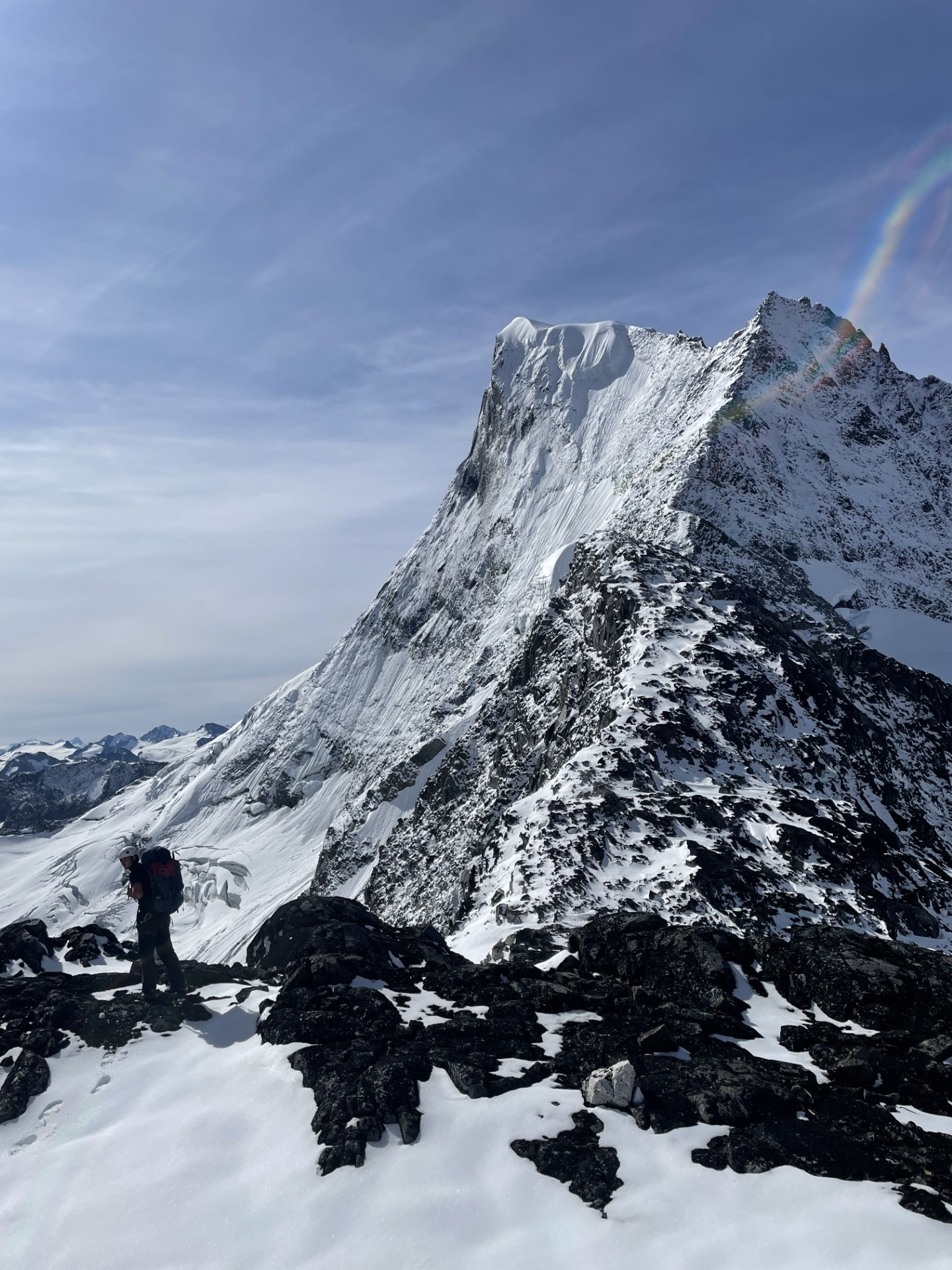
I descended to meet him. He had his foot propped up on his knee, inspecting his steel crampons. One of the points had bent a full forty-five degrees from the impact, but miraculously, his foot was completely unharmed. He held up his hands to show that the falling rock had been roughly head sized, he got lucky. I was reminded at that moment of how remote our position was, and was thankful we had made the decision to turn around when we did. We couldn’t afford to be stranded up there.
After nine rappels off slings, we finally reached our ridge camp as the sun was setting. I felt shaken, thoroughly spent, but grateful to be standing in such an incredible location. Few get to experience what we have, being so far removed from the normality that life usually presents. It reminded me that the summit was not the point. Many things are done just to be forgotten. This trip was something that neither of us will ever forget - you don’t get a lot of moments like that, and that was special enough.
I am immensely grateful to our friends and family, along with the support from the ACCVI Memorial Fund Youth Grant that were integral in our ability to pull off an expedition of this magnitude. We are so thankful for the generosity and the unwavering enthusiasm that we have received from our community for this adventure, it truly could not have been done without them.